
How to Plate with Microgreens
Where to put them, how much, which way up, and when to leave them off. The technique chefs use to make a garnish look deliberate rather than sprinkled.
A microgreen garnish either reads as intentional or it reads as confetti, and the difference is technique rather than quantity. The rules below are the ones that separate the two, in roughly the order they matter.
Place, do not sprinkle
This is the whole thing. Scattering greens across a plate spreads the eye out; placing them in one spot gives the plate a focal point. Take a pinch, stand the stems roughly in the same direction, and set them down as a small cluster — one, or at most two or three of clearly different sizes.
If you need to cover an area rather than mark a point, still place rather than sprinkle: lay a line of shoots along an edge with the stems all running the same way. Deliberate repetition reads as design; random distribution reads as an accident.
Height is why you bought them
Most of a plate is flat. Microgreens are the cheapest height available, and the way to get it is to lean the cluster against something — the side of a protein, the edge of a quenelle, the lip of a bowl — so the stems stand at an angle rather than lying down. Greens laid flat on a flat plate have given up their only structural advantage.
Pick the variety for this on stem stiffness. Radish and sunflower stand up; pea shoots drape; cilantro collapses. All three are useful, but only if you choose knowingly.
Point the leaves up
Sounds fussy, matters more than it should. The leaf is the part with colour and the stem is the part with none, so a cluster set leaf-up looks green and a cluster set stem-up looks like cut grass. Taking the pinch out of the punnet in one direction keeps them aligned; dumping and re-picking them does not.
How much
Two to five grams for a garnish — visibly less than instinct suggests. If the greens are the first thing you see when the plate lands, there are too many, unless the dish is a salad and they are a component rather than a finish. In that case, 30 to 50 grams and they are the dish.
The strong-flavoured varieties set their own limit. Radish, arugula and mustard will dominate a delicate dish at a quantity that still looks sparse, so on those, taste is the constraint, not the look.
Last, always
Microgreens go on at the pass, after sauce, after anything hot, immediately before the plate leaves. They wilt in about a minute under a heat lamp and in seconds on a hot surface. If a plate is going to wait, the greens wait with it in the fridge and go on when it moves.
Never on the sauce
Greens set into a warm sauce or a hot jus absorb it, go limp and darken within a minute. Rest them against a solid element instead, or on a dry part of the plate — the flavour of the sauce reaches them anyway once it is eaten.
Matching the variety to the plate
- Radish — pink-stemmed and stiff, cuts rich dishes. Best on fat: pork belly, cheese, anything creamy.
- Sunflower — substantial and sweet, the one that can be a pile rather than a pinch. Good on salads, toast, grain bowls.
- Pea shoots — tendrils and curves, the most graceful shape. Excellent on cold plates, fish, anything where you want movement.
- Arugula — dark, small, strongly flavoured. A seasoning you can see.
- Cilantro — herb flavour with a delicate leaf. For Thai and Latin dishes where the taste is doing the work, not the shape.
When to leave them off
A garnish that does not belong on a dish is worse than no garnish. Leave them off anything deep-fried and still hot, anything that goes to the table under a cloche, anything in a soup that will be stirred, and anything already green — a plate of green on green has no contrast, and contrast was the reason for adding them.
And leave them off when the flavour is wrong. A peppery brassica on a delicate custard is not a decoration, it is an ingredient someone did not think about. If the dish does not want the taste, it does not want the garnish.
Prep and handling on the line
- Keep the punnet cold and closed until service; take out what a service needs, not the box.
- Do not wash. Washed microgreens are unusable within hours and cannot be dried back to crisp.
- Pick out any seed hulls still clinging to leaves when you portion, not when you plate.
- If they have gone limp, ten minutes in ice water brings most of it back — then dry them completely before they go near a plate.
If you are ordering for a kitchen rather than a home, our guide to microgreens for restaurants covers quantities, shelf life through a service week and what to ask a grower.
Featured in this article
Try these microgreens
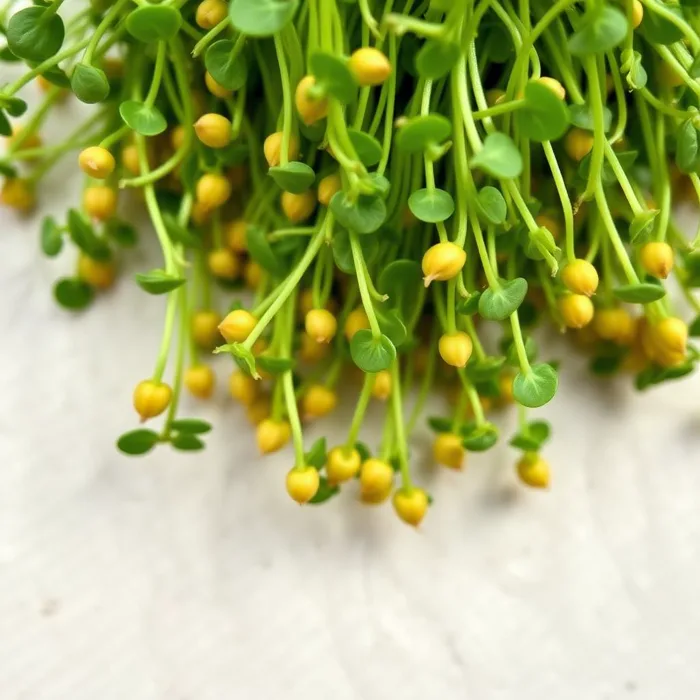
Nutty, crunchy, slightly sweet — a salad favourite.
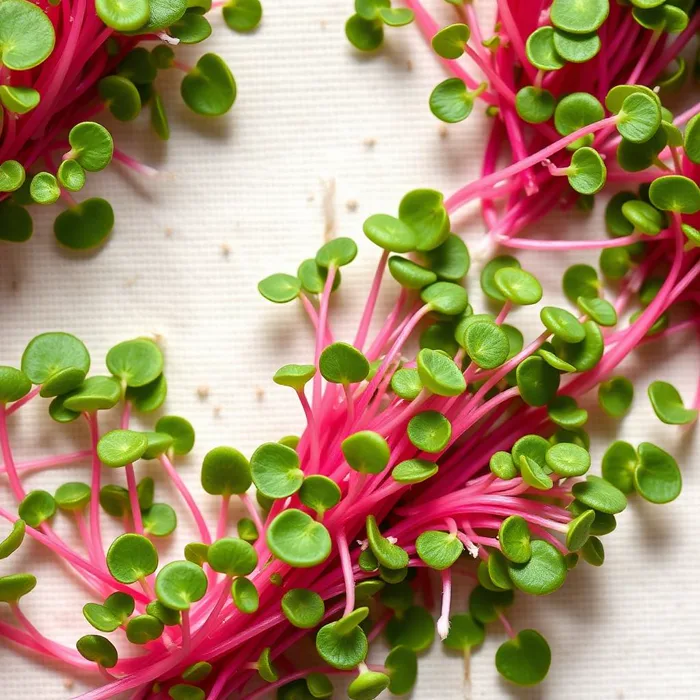
Peppery and bright with vibrant pink stems.
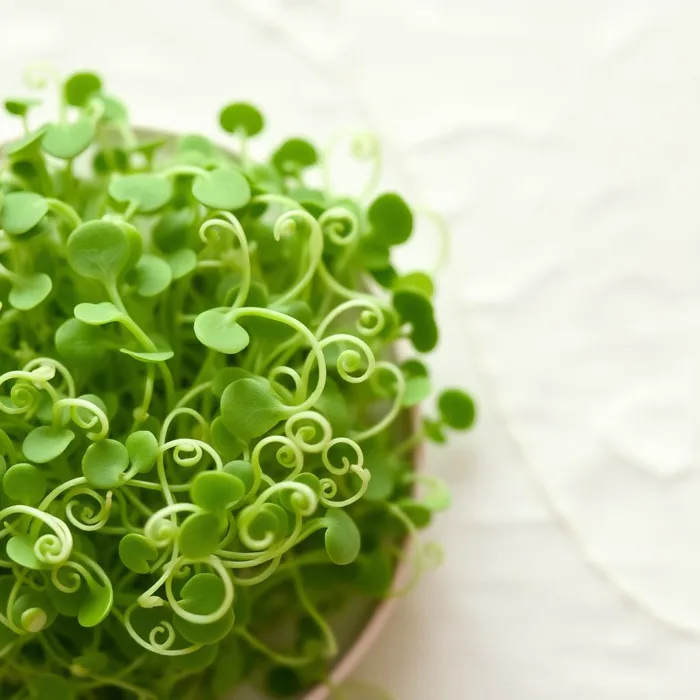
Sweet, fresh and tender — like garden peas.
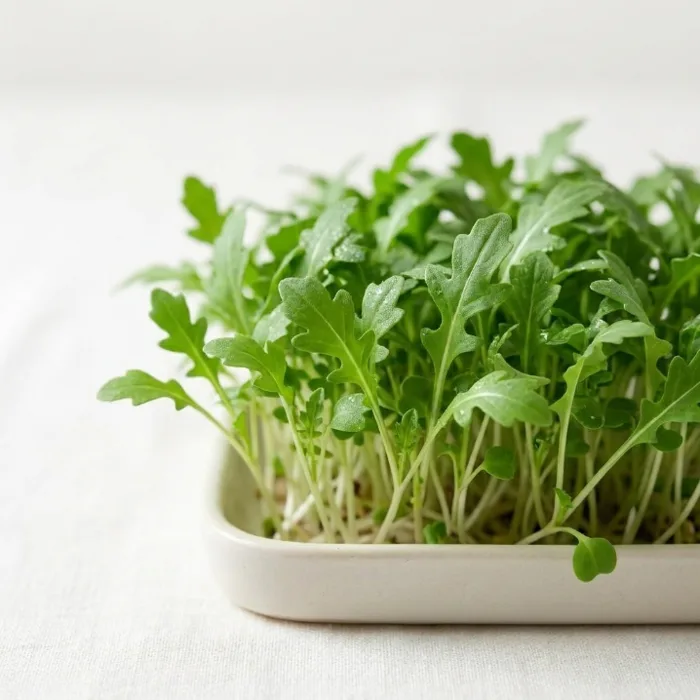
Bold, peppery, and slightly nutty with a crisp, fresh bite.

Fresh, citrusy, and aromatic with a delicate herbal finish.