
How to Grow Sunflower Microgreens at Home
Ten days from dry seed to a tray you can cut. The method we use on the farm, scaled down to one tray on a windowsill — including the two steps most home growers get wrong.
Sunflower is one of the easier microgreens to grow and one of the easiest to ruin. The seeds are large and forgiving, but they are also the most likely of any crop we grow to turn mouldy if the tray is crowded or the air is still. Get the soak and the weight right and the rest looks after itself.
What you need
- Black oil sunflower seed, untreated and sold for sprouting — not bird seed, and not seed treated for field planting.
- Two shallow trays, one with drainage holes and one without, that stack.
- Potting mix or coco coir, about 3cm deep.
- A spray bottle, and somewhere with indirect light.
Day 0 — soak
Cover the seed with cool water and leave it for 8 to 12 hours. Longer than that and the seed starts to ferment; you will smell it. Drain and rinse. One level cup of dry seed covers a standard 25×50cm tray.
Day 0 — sow and weigh down
Fill the drainage tray with moist — not wet — medium and level it. Scatter the soaked seed in a single dense layer, touching but not piled. Mist, then invert the second tray on top and put something heavy on it: a few books, or a couple of bottles of water.
The weight is the whole trick
Pressing down is what makes the shoots push up straight, tall and even, and it is what forces most of the seed hulls off the leaves. Skip the weight and you get a short, patchy tray wearing black hulls you will be picking off for a week.
Days 1–3 — blackout
Keep the tray covered and weighted in the dark. Lift it once a day to mist and to let the air change. By day three the shoots should be pale, several centimetres tall, and pushing the top tray up on their own.
Days 4–8 — light
Take the cover and the weight off. The shoots will be yellow; a day of indirect light turns them green. From here, water from below — pour into the outer tray and let the medium drink it up. Water landing on the leaves is the single most common cause of mould.
Days 8–12 — cut
Harvest when the two seed leaves are open and flat and before the first true leaf appears between them — after that the flavour turns bitter. Cut with scissors just above the medium. The tray does not regrow; compost it and start again.
If it goes wrong
- White fuzz on the medium that disappears when misted is root hair, not mould. Mould is grey, spreads across the seed, and smells.
- Shoots falling over — too wet, and not enough airflow.
- Short and uneven — not enough weight during blackout.
- Bitter — cut too late.
The seed is the part worth spending on: sprouting-grade seed germinates evenly and has not been treated with anything you would rather not eat. We sell the same seed we sow on our own trays.
Featured in this article
Try these microgreens
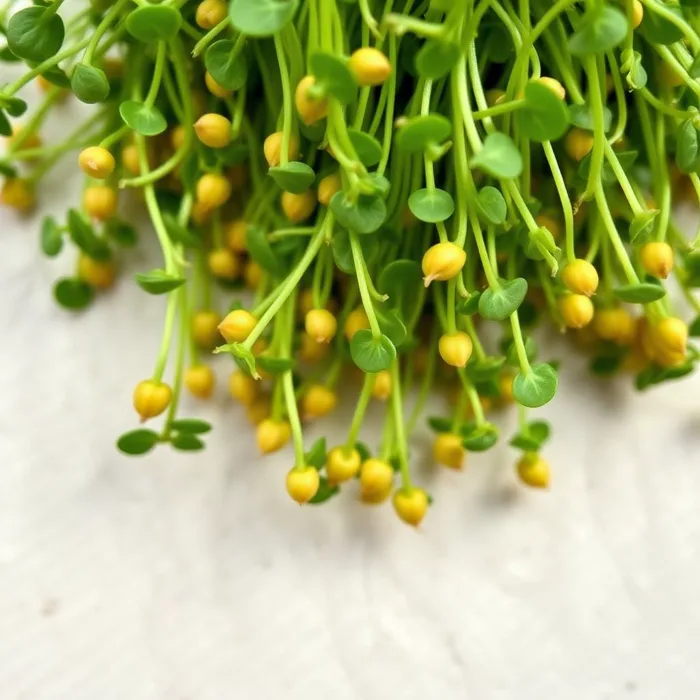
Nutty, crunchy, slightly sweet — a salad favourite.